Website Design for a Luxury Resale E-commerce Platform

LUXEA

E-commerce

Website Design

Design System

3-4 min read

My role:

UX consulting, Website Design, Interaction Design, Prototyping

My role:

UX Research, Personality Design

My role:

User Research, Personality Design, Conversation Prototyping

Team:

Solo Designer, Business Stakeholder, Engineering Team

Team:

Group of 4

Tools:

Figma, Figma Make, Notion, Claude

Tools:

Figma, FigJam

Duration:

2 Months

Duration:

4 Months

Overview

Introduction

LUXEA is an AI-driven resale platform that connects Taiwanese buyers with Japanese luxury goods. The aim is to help buyers to make better purchasing decisions through price comparison, condition transparency, and AI-powered product discovery.

My Role

I worked as a product designer, leading design execution from translating business strategy to development handoff. I worked closely with a cross-functional team to bring the idea to life.

Problem

The secondhand luxury market in Taiwan currently scatter across KOL resellers, livestream sales, and boutique listings. This creates three friction points:

  • Findability — cannot find what's actually available in Japan

  • Price transparency — cannot tell whether a listed price reflects fair market value

  • Trust — cannot judge items' condition, authenticity, or seller reliability

LUXEA aims to convert the situation by creating a coherent, trustworthy product experience that makes items searchable, comparable, and available.

Goal

Frictionless Conversion

Reduce friction between discovery and purchase to lift business conversion.

Establish Trust Signals

Design an elevated, modern luxury aesthetic and supporting information that builds credibility for the brand.

Solution

AI Photo Search

Upload or snap a picture to retrieve matching inventory, current market price bands, and similar alternatives.


AI Photo Search

Upload or snap a picture to retrieve matching inventory, current market price bands, and similar alternatives.


AI Photo Search

Upload or snap a picture to retrieve matching inventory, current market price bands, and similar alternatives.


Transparent Condition & Price Index

Standardized condition tags paired with live price comparisons.

Transparent Condition & Price Index

Standardized condition tags paired with live price comparisons.

Transparent Condition & Price Index

Standardized condition tags paired with live price comparisons.

AI Sourcing Assistant

Automated fallback modal allowing users to submit custom sourcing requests on empty search states.

AI Sourcing Assistant

Automated fallback modal allowing users to submit custom sourcing requests on empty search states.

AI Sourcing Assistant

Automated fallback modal allowing users to submit custom sourcing requests on empty search states.

Competitive Analysis

I evaluated five platforms, spanning from Japanese resale marketplaces to global luxury e-commerce sites. Here are some takeaways I synthesized to enhance the design:

Verification and Trust Visibility

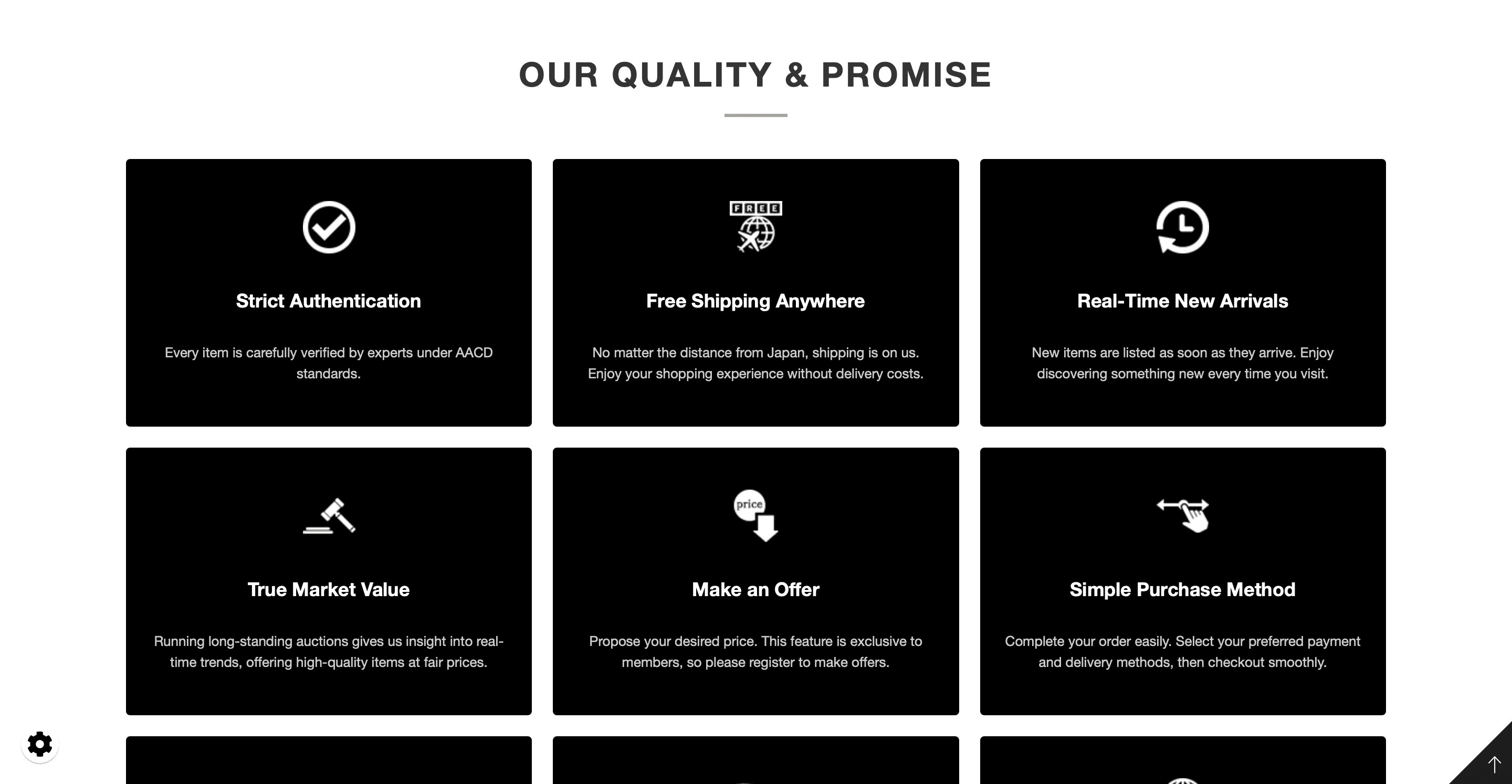
Authenticity checks must appear directly where decisions are made to reduces hesitation on high-ticket items. Competitors that led with authentication guarantees and visualized condition grading appeared more credible at a glance.

Scarcity Signaling

Retaining recently sold or almost sold-out inventory signals marketplace liquidity and creates purchase urgency. Keeping sold-out listings visible, with a "Sold Out, Find Similar" tag, turns dead clicks into active recommendations.

Editorial Restraint

Generous spacing, off-black typography, and zero clutter establish immediate credibility as luxury. 

Branding & UI

Color Choices

To balance between high-fashion sophistication and an approachable e-commerce experience, I established a warm but restrained visual palette.

Design System

To maintain consistency and ensure efficient design to dev handover, I developed a modular design system based on reusable components and their states.

High Fidelity

Screen Flow

I mapped the full-screen-based user flow, including happy path and edge cases, and annotated each screen to support engineering implementation.

Reflection

Learning

Designing for Developer Empathy

A design file is only useful if developers can build it easily. Hence, I worked to remove any confusion by using clear screen flows, structured tokens, and prototypes that showed exactly how scrolling and interactions should work.

Thinking Beyond the Happy Path

Real-world product success depends on how well it handles edge cases. I planned for situations beyond the ideal, like file size limits, missing inventory, and network timeouts, so the experience stayed reliable in all scenarios.

Pragmatic Prioritization under Constraints

UX improvement is endless, but launch timelines are fixed. I learned to prioritize high-impact changes that have the most business impact rather than chasing perfection.

Constraint

The design decisions are grounded in competitive pattern matching and business logic, not in direct validation with LUXEA's actual users.

Constraint

The design decisions are grounded in competitive pattern matching and business logic, not in direct validation with LUXEA's actual users.

Constraint

The design decisions are grounded in competitive pattern matching and business logic, not in direct validation with LUXEA's actual users.

Future

  • Track conversion performance of AI features post-launch.

  • Conduct task-based testing on core flows during initial releases.

Future

  • Track conversion performance of AI features post-launch.

  • Conduct task-based testing on core flows during initial releases.

Future

  • Track conversion performance of AI features post-launch.

  • Conduct task-based testing on core flows during initial releases.

Create a free website with Framer, the website builder loved by startups, designers and agencies.